
Megaproject Meltdown: The $33 Billion Bullet Train That Became a $128 Billion Case Study
 Edmund J. Martinez, MBA, MPH, PMP
8 min read
Edmund J. Martinez, MBA, MPH, PMP
8 min read
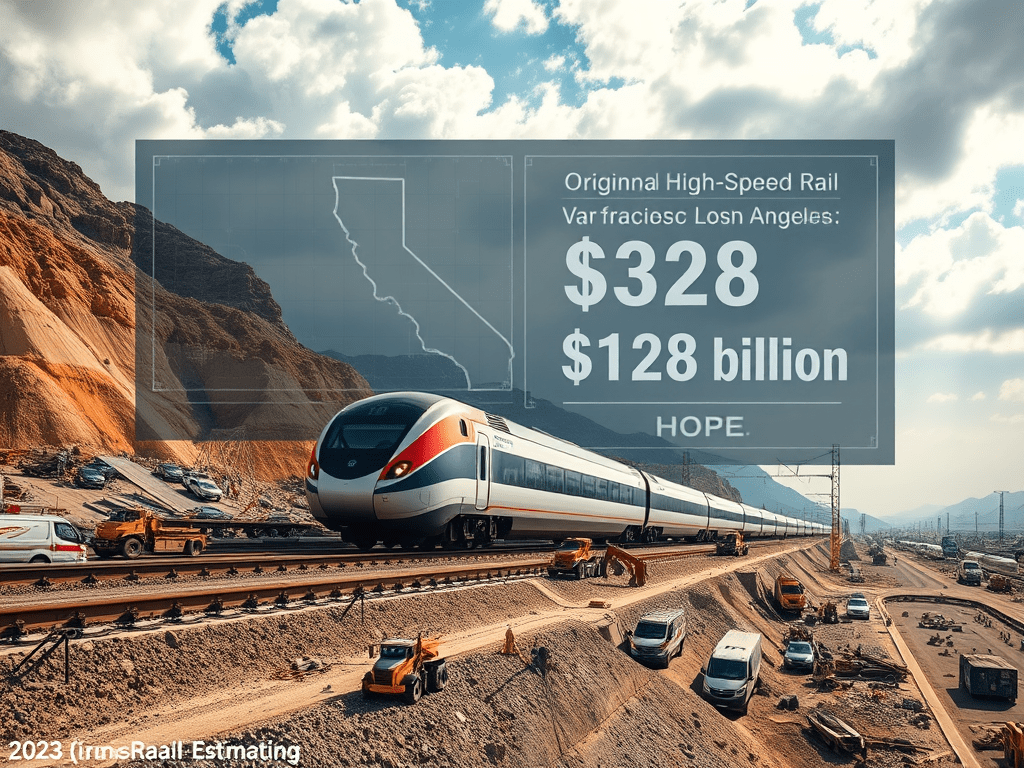
The California High-Speed Rail (CHSR) project, initially conceived to link the megalopolises of San Francisco and Los Angeles, stands as a monumental, real-world case study in the perils of poor scope definition, inadequate risk management, and cost escalation in infrastructure megaprojects.
The original promise, delivered to voters in 2008, was a system that would connect California’s two great regions in under three hours for a projected cost of approximately $33 billion and completed by 2020 (California High Speed Rail Authority, 2008). Today, the estimated cost for Phase 1 (San Francisco to Anaheim) has ballooned to as high as $128 billion, more than three times the initial projection, with construction focusing on a 171-mile segment in the Central Valley (Ohanian, 2023). This staggering increase provides invaluable, if cautionary, lessons for anyone involved in managing large-scale capital investments.
The Case for High-Speed Rail: Strategic Pros
From a macro-economic and societal perspective, the construction of CHSR brought a powerful set of pros that initially justified the investment:
| Pro | Strategic Rationale |
|---|---|
| Economic Stimulus & Job Creation | The project was forecast to generate thousands of construction and ancillary jobs, creating centers of economic activity around new stations and improving labor market access across the state. |
| Environmental Benefits | An electrified rail system provides a cleaner, lower-carbon alternative to air and car travel, helping California meet its aggressive climate goals by diverting millions of annual short-haul flights and long-distance driving trips. |
| Alleviating Capacity Constraints | Expanding highway and airport capacity to meet California’s projected population growth was estimated to cost more than the high-speed rail itself, positioning HSR as the better long-term Value for Money investment for mass transit. |
| Safety and Speed | HSR offers one of the safest modes of transportation while significantly cutting intercity travel time, enhancing business efficiency and quality of life. |
The Scope Failure: A Breakdown in Project Governance
The critical flaw in the CHSR narrative lies not just in the size of the budget increase, but in the systemic failure to adequately define, control, and manage the project’s scope, a foundational pillar of successful project management.
The Measure of Failure: Cost Overrun
The current high-end estimate of $128 billion against the $33 billion initial figure represents a 388% cost overrun. For project managers, this magnitude of variance signals a complete breakdown of the original Project Charter and risk models.

Contributing Factors to Scope Creep and Cost Escalation:
- Inadequate Planning and Risk Assessment: The initial business plans were criticized for lacking essential details on funding sources, segment-by-segment cost distribution, and, most crucially, a systematic assessment of inherent risk (U.S. Government Accountability Office, 2013). This omission of a robust risk register ensured that unanticipated issues would become catastrophic cost events.
- Starting Before Design Completion: To meet strict federal funding deadlines, the California High-Speed Rail Authority (CHSRA) initiated construction on the Central Valley segment before securing all final designs and necessary Right-of-Way (ROW). This “start-fast” approach led to costly change orders, contractor disputes, and delays as designs had to be reworked around existing utility lines and unexpected geographical challenges (Ohanian, 2023).
- Right-of-Way (ROW) Acquisition Challenges: The project dramatically underestimated the time and cost involved in acquiring thousands of parcels of land, navigating complex environmental permitting, and fighting protracted legal battles with property owners and freight railroads. These delays forced the project schedule to stretch over years, during which construction inflation compounded the financial damage.
- The Shrinking Scope: Due to the fiscal crisis, the project’s scope has been significantly narrowed from the San Francisco-to-Los Angeles goal to the Initial Operating Segment (IOS) between Merced and Bakersfield. In a classic example of De-scoping, the state is now building a segment that, on its own, costs more than the original budget for the entire line, and does not connect any major population centers, severely undermining the initial ridership forecasts and economic justification.
East vs. West: Why Shinkansen Soared While California’s HSR Stalled
The dream of high-speed rail in California, connecting its major metropolitan hubs, inevitably draws comparisons to the world’s pioneering high-speed rail system: Japan’s Shinkansen. While both projects aimed to revolutionize intercity travel, their journeys from conception to reality couldn’t be more different. The Shinkansen’s expedited development and operational success offer a stark contrast to California’s decades of delays, cost overruns, and political quagmires, providing critical lessons in project execution, governance, and political will.
The Dawn of High-Speed: A Tale of Two Timelines
| Project | Inception to Operation (Initial Segment) | Original Cost (Inflation-Adjusted) | Current Status |
|---|---|---|---|
| Shinkansen (Tokaido Line) | 1959-1964 (5 years) | ~$2.5 Billion (1964 USD) | Fully operational, expanded, profitable |
| California HSR | 2008-Present (16+ years and counting) | ~$33 Billion (2008 USD) | Limited construction in Central Valley, no operational segment |
Japan’s Shinkansen: Centralized Authority, Expedited Approval
The Tokaido Shinkansen, connecting Tokyo and Osaka, debuted in 1964, just in time for the Tokyo Olympics. Its rapid development was facilitated by a unique confluence of factors rooted in Japan’s post-war reconstruction and governmental structure:
Pros of Japan’s Approach:
- Centralized Planning & Funding: The success of the Tōkaidō Shinkansen, initiated by the Japanese National Railways (JNR), is often attributed to a centralized governance and funding model that starkly contrasts with the fragmented, multi-jurisdictional structure of the California High-Speed Rail (CAHSR) project. This difference in organizational power and authority directly impacted the scope definition, execution speed, and cost control of each mega-project.
The JNR, operating as a singular, state-owned entity with a national mandate, was able to secure a dedicated right-of-way and a clear, unified vision for the project, enabling streamlined decision-making and rapid completion (IIASA, 1980). Conversely, the CAHSR project, managed by the California High-Speed Rail Authority (CHSRA), must navigate a complex landscape of federal, state, and local governments, resulting in necessary political compromises like the “blended system” and protracted legal and environmental processes (California High Speed Rail Authority, 2024). - Eminent Domain & Reduced Legal Challenges: The speed and dedication of land acquisition represent one of the most significant differences between the Japanese National Railways (JNR) Tōkaidō Shinkansen and the California High-Speed Rail (CAHSR) project. JNR, supported by the Japanese government, operated with a centralized national authority that streamlined the land acquisition process and minimized legal and environmental opposition for its initial construction (IIASA, 1980). This unified approach enabled the project to secure the necessary right-of-way quickly, contributing to the rapid construction timeline.
In sharp contrast, the CAHSR project is managed by the California High-Speed Rail Authority (CHSRA) within a highly litigious and politically fragmented environment (Ohanian, 2023). The California project has faced hundreds of eminent domain lawsuits as it attempts to acquire land, particularly in the Central Valley, leading to construction delays, increased costs, and project segmentation (San Joaquin College of Law, 2018). Furthermore, the regulatory environment in the U.S. and California introduces extensive environmental and judicial reviews—processes that were either less restrictive or politically circumvented during the JNR’s initial push in the 1960s. - Technological Prowess & Focus: Japan was a leader in railway technology. The Shinkansen project was viewed as a national priority, fostering rapid innovation and a singular focus on engineering and construction excellence without significant deviations in scope or design.
- Public Consensus & Urgency: The project garnered broad public and political support, seen as crucial for national development and a symbol of Japan’s technological resurgence. This consensus reduced opportunities for opposition groups to halt or significantly alter the project’s trajectory.
| Feature | JNR Shinkansen (Tōkaidō, circa 1960s) | California High-Speed Rail (CAHSR, ongoing) |
|---|---|---|
| Governance | Centralized and Unified. Managed by the single, state-owned JNR (planner and builder). | Fragmented and Distributed. Managed by the CHSRA, but influenced by multiple state, regional, and federal agencies. |
| Right-of-Way (ROW) | Dedicated and Independent. Built on entirely new, standard-gauge track, fully grade-separated to ensure maximum speed. | Blended and Shared. Uses dedicated new tracks in the Central Valley but shares or upgrades existing rail corridors (e.g., with Caltrain) in metropolitan areas, compromising speed. |
| Scope & Speed | “Gold Standard” from the Start. Unified technical objective to build a continuous, high-speed line with minimal curves. | Changing and Evolving Scope. Initial large-scale vision scaled back to focus on a shorter initial segment; speed is reduced on shared tracks. |
| Funding & Political Support | Strong, Sustained National Will. Single-source commitment from the Japanese government and World Bank loan (IIASA, 1980). | Inconsistent and Politicized. Relies on a volatile mix of state bond money, federal grants, and state Cap-and-Trade revenue (California High Speed Rail Authority, 2024). |
| Environmental/Legal | Streamlined. The national entity had the authority for direct land acquisition. | Protracted and Complex. Lengthy process of securing environmental clearances for separate sections and acquiring numerous parcels due to multi-jurisdictional requirements and legal challenges (California High Speed Rail Authority, 2024). |
Lessons for Future Megaprojects
The CHSR saga offers a painful but valuable set of lessons for both project managers and business strategists:
- Front-End Loading is Non-Negotiable: A megaproject’s fate is often sealed in its first year. Thorough front-end loading—robust preliminary engineering, risk identification, and comprehensive planning before shovels hit the dirt—is the only way to safeguard the budget.
- The Cost of Inaccuracy: Underbidding a project to gain political support (a phenomenon known as “optimism bias”) is a short-sighted strategy that destroys stakeholder trust when inevitable cost corrections occur.
- Scope Baseline is King: The lack of a clear, stable, and federally aligned Scope Baseline from the outset resulted in continuous ambiguity, leading to the contentious and costly disputes referenced in the Authority’s own reports (California High Speed Rail Authority, 2024).
While the Shinkansen project was an ambitious project delivered on time and within budget, becoming a global benchmark for efficiency and reliability, the California High-Speed Rail project is a sobering testament that even the most ambitious and beneficial infrastructure goals will fail under the weight of poor project governance and a dangerously undefined scope.
Works Cited
- California High Speed Rail Authority. (2008, November). 2008 Business Plan. Retrieved from California High Speed Rail Authority: https://hsr.ca.gov/wp-content/uploads/docs/about/business_plans/BPlan_2008_FullRpt.pdf
- California High Speed Rail Authority. (2024). 2024 Business Plan. Retrieved from California High Speed Rail Authority: https://hsr.ca.gov/wp-content/uploads/2024/05/2024-Business-Plan-FINAL.pdf
- IIASA. (1980). The Shinkansen high-speed rail network of Japan: Proceedings of a conference (CP-81-702). Retrieved from International Institute for Applied Systems Analysis: https://pure.iiasa.ac.at/id/eprint/1225/1/XB-80-508.pdf
- Ohanian, L. E. (2023). Challenges in Implementing High Speed Rail: Lessons From California’s Experience [Testimony]. Retrieved from https://transportation.house.gov/uploadedfiles/2023-11-29_mr._ohanian_-_testimony.pdf
- San Joaquin College of Law. (2018). High speed leftovers: Takings and just compensation. Retrieved from San Joaquin Agricultural Law Review, 27(1), 95-122: https://www.sjcl.edu/images/stories/sjalr/volumes/V27N1C1.pdf
- U.S. Government Accountability Office. (2013, March 29). California High-Speed Passenger Rail. Retrieved from U.S. Government Accountability Office: https://www.gao.gov/products/gao-13-304